

Identity safety
- Verified phone numbers, email addresses, and channel identities are matched only within the current workspace.
- Display names and transcript content are never used to merge contacts.
- Conflicting identities are never merged automatically.
- Business sender identities are not treated as the customer’s identity.
- Email memory requires authenticated sender verification; the visible sender text or message body alone is not enough.
- Anonymous browser calls and chats do not participate in cross-channel memory.
Configure the workspace
Open Workspace Settings → Data → Memory to enable memory, select allowed channels, require consent, and choose a rolling retention period. An assistant can narrow the workspace policy under Assistant → Settings → Privacy → Caller memory by selecting read channels, write channels, categories, and a scope.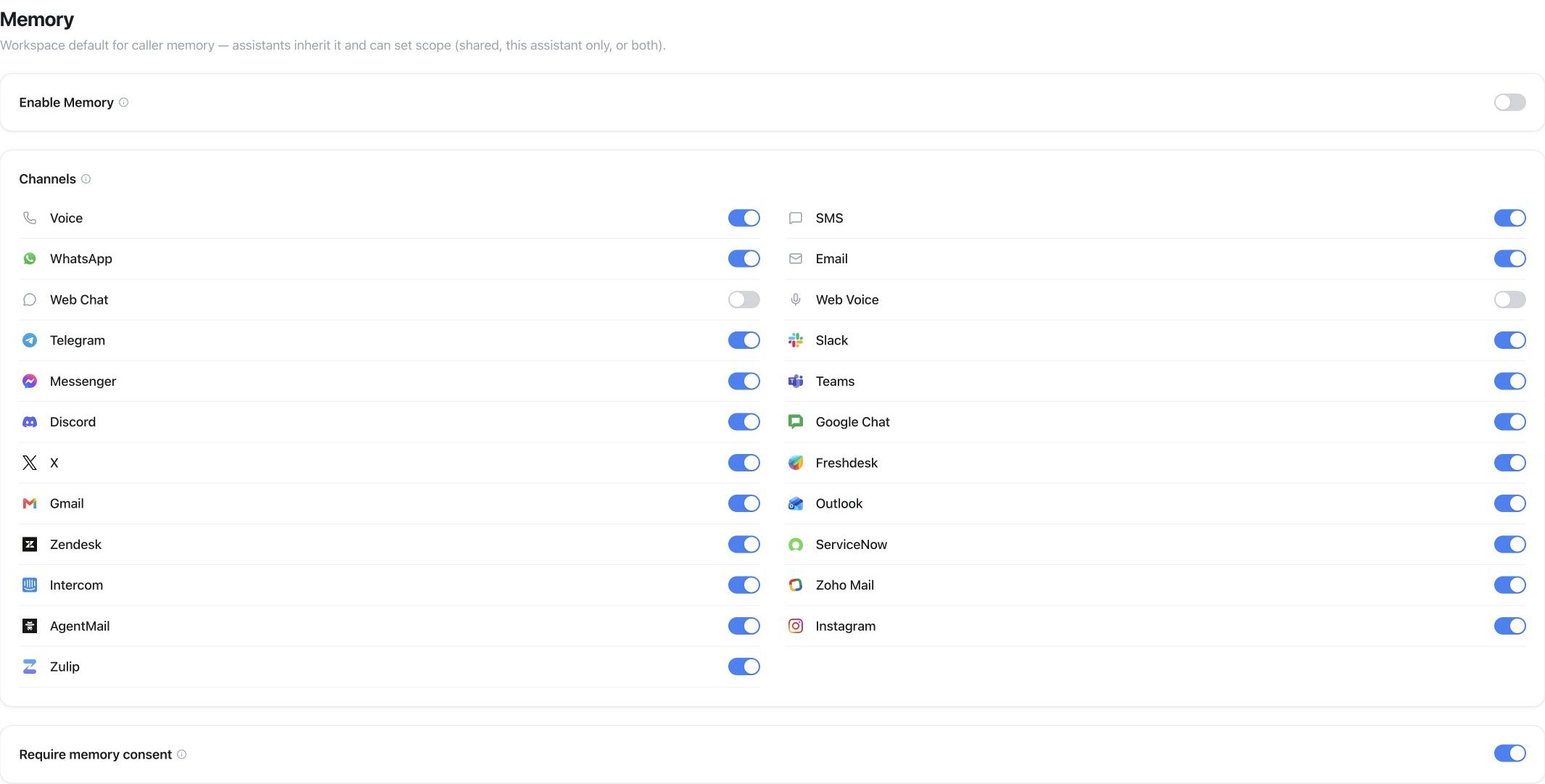
Settings → Memory: use Enable Memory for the workspace, choose its Channels and review Require memory consent. This example has the master switch off.
Remembered variables use the same consent, channel, retention, staleness, and erasure rules as conversation memory. Lead attributes are already workspace contact fields and therefore remain shared. A Shared variable key identifies one workspace-wide datum: use the same key only when every assistant means the same thing by it.
Retention and staleness are separate, independently configured settings. Retention decides how long a memory record exists at all — every successful update renews the rolling window, or you can choose to keep records until manually deleted; once retention lapses, the record is deleted. Staleness is optional and off by default: enable it and choose a number of days without a successful memory update. Stale content is no longer injected or reused. A later eligible conversation can create fresh memory from that conversation, while the old content remains unavailable until retention cleanup removes it.
Every read, write, consent change, skip, and deletion is audited. Audience → Memory lets workspace admins grant or withdraw consent and erase all shared and assistant-scoped memories for a contact.
API and MCP
GET/PATCH /api/v1/settings/memorymanages the workspace’s allowed channels, consent policy, and retention period.GET /api/v1/contacts/memorylists customer memories.GET/PATCH/DELETE /api/v1/contacts/{id}/memoryreads, updates, or erases a contact’s memory. An update must provide the current revision; a stale revision returns409.- Assistant updates can define the memory scope, read and write channels, allowed categories, and the
none,workspace, orassistantpolicy on each custom variable.
Only retain customer context with a lawful basis. Explicitly denied consent always prevents memory reads and writes. Unknown consent also blocks when the workspace requires consent.
search parameter (up to 200 characters), and the list_customer_memories MCP tool offers the same search.