> ## Documentation Index
> Fetch the complete documentation index at: https://docs.famulor.io/llms.txt
> Use this file to discover all available pages before exploring further.
# Knowledge bases
> Help assistants answer from your documents and websites
A knowledge base gives an assistant approved information about your products, policies, opening hours, prices, and other business topics. When a caller asks a related question, the assistant can use the most relevant parts of your content instead of guessing.
## How it works
Everything you add is split into short passages and indexed. During a conversation, the caller's question is matched against that index, and only the best-matching passages are handed to the assistant as background for its answer — not the whole document, and not the whole knowledge base.
That has one practical consequence: the assistant only ever sees the passages that matched. If the answer to a question is spread across three documents, or the condition that qualifies it sits in a different section than the fact itself, the retrieved passage may be true but incomplete. Writing each topic as a self-contained section is what makes retrieval reliable — see below.
### How content is prepared
Before indexing, every item is prepared so that each passage can stand on its own:
* **Every passage starts with its source**: the document name (without file extension) or the page title, followed by the section heading, for example `Speisekarte › Pizza Hawaii › Zutaten`.
* **Headings split documents into sections**: Word headings (Heading 1–6 styles), Markdown headings (`#`) in text and Markdown files, and the headings of HTML files and web pages.
* **PDF page clutter is removed**: page numbers disappear, and headers or footers that repeat on almost every page are kept only once.
* **HTML files are cleaned like websites**: cookie banners and consent dialogs are removed.
Tables (CSV, TSV, XLSX and Google Sheets) keep their own row-based format, see [Tables](#tables-csv-tsv-xlsx-and-google-sheets).
## Create and connect a knowledge base
 Open **Knowledge bases → New**, enter a name, and add a short description of the content.
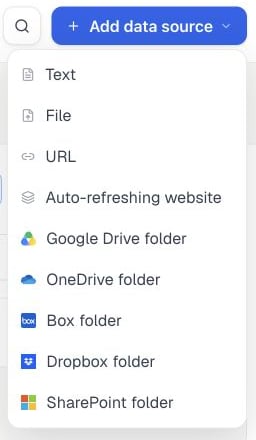
Upload PDF, DOCX, HTML, or text files. You can also add text, document URLs, or a website source.
Each item shows its status. If an item cannot be processed, open it to see what needs to be changed.
Use **RAG Search** to ask real customer questions and preview the passages an assistant would find. Improve any document that comes back unclear or contradictory.
Select the knowledge base in the assistant editor. No prompt change is required.
Open **Knowledge bases → New**, enter a name, and add a short description of the content.
Upload PDF, DOCX, HTML, or text files. You can also add text, document URLs, or a website source.
Each item shows its status. If an item cannot be processed, open it to see what needs to be changed.
Use **RAG Search** to ask real customer questions and preview the passages an assistant would find. Improve any document that comes back unclear or contradictory.
Select the knowledge base in the assistant editor. No prompt change is required.
 ## List documents and indexed chunks
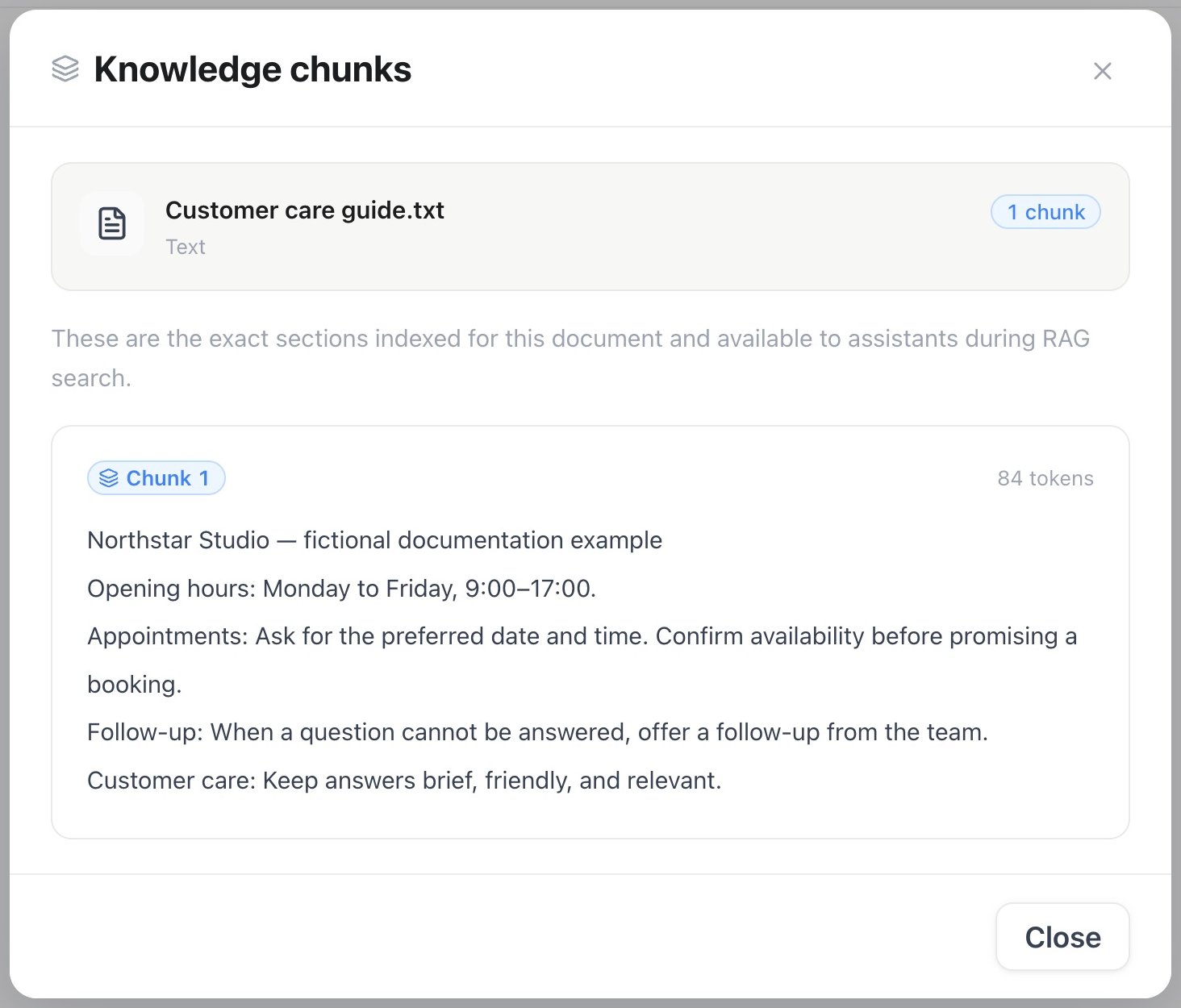
The document list shows every item in a knowledge base — uploaded files, text, file URLs, web pages, crawled website pages and cloud drive files — with its status and number of indexed chunks.
For API or MCP access, use `GET /knowledge-bases/{id}/documents` or `list_knowledge_documents`. Results are sorted newest first and paginated with `limit` (1–200, default 50) and `offset` (default 0). The API returns the total number of documents in `meta.pagination.total`; MCP returns `total`. An unknown or invalid knowledge base ID returns a not-found error.
Pass a document ID from that list to `GET /knowledge-bases/{id}/documents/{docId}/chunks` or `list_document_chunks` to read the exact passages indexed for that document. Listing documents or chunks only reads the current index; it never refreshes a source or uses credits. API access requires `knowledge:read`; MCP also accepts `assistants:read`.
## Delete documents
Hover over a document in the list and tick its checkbox (on touch screens the checkboxes are always shown). Once a document is selected, the bar above the table lets you select all documents, clear the selection or delete the selected documents. Deleting removes the documents, their indexed chunks and their stored original files, so assistants stop using that content right away. Pages from an Auto Refresh website come back on the next refresh unless you add them to that source's **Exclude paths**; files from a cloud drive come back on the next sync unless you remove them from the synced folder.
| | One document | Several documents (up to 200) |
| - | - | - |
| API | `DELETE /knowledge-bases/{id}/documents/{docId}` | `POST /knowledge-bases/{id}/documents/delete` with `document_ids` |
| MCP | `delete_documents` | `delete_documents` |
| CLI | `famulor delete-knowledge-base-document ` | `famulor delete-knowledge-base-documents --document-ids ,` |
IDs that do not exist in this knowledge base, or were already deleted, are returned in `not_found_ids` instead of failing the request, so a retry is safe. API access requires `knowledge:write`; MCP also accepts `assistants:write`.
## Write content that answers well
* Use a clear heading for each topic.
* Keep the facts and conditions needed for an answer in the same section.
* Put important numbers in text, not only in complex tables.
* Remove outdated or contradictory copies.
* Prefer one subject per document where practical.
* Watch latency on very large knowledge bases, especially many heavy PDFs — converting core content to text files usually processes and retrieves faster.
## Import a website
Add a website source with a root URL. You can limit it to selected path prefixes, exclude unwanted sections, and set the maximum number of pages to import. A path such as `/produkte` covers every page that starts with it; end a path with `$` to match only that exact page, for example `/datenschutz$`.
Before saving, choose **Load pages** beside **Website URL** to preview crawlable same-host pages. The preview checks `robots.txt` and available sitemaps, does not index anything, and spends no credits. Review the suggested sections, then explicitly add a path to **Include paths** or **Exclude paths**; suggestions are never saved automatically. Suggested exclusions also list privacy, cookie and accessibility pages; the imprint and terms pages are never suggested.
Each previewed page has a checkbox. Ticking or unticking a page updates **Include paths** and **Exclude paths** for you with an entry for exactly that page (ending in `$`, for example `/impressum$`), and a counter shows how many pages are selected. **Maximum pages** follows your selection: it rises automatically so every include path and every ticked page fits, and you can also type an exact number. If you set it lower than the number of matching pages, the dialog warns you, because pages beyond the limit are not indexed. A source under **Auto Refresh** shows the same warning when it has more include paths than its page limit. A page that a broader exclude path such as `/blog` removes can only be changed in **Exclude paths**.
Run the import once, or enable automatic synchronization to check the site again at your chosen interval, from every 6 hours up to every 6 months. Only new or changed pages use import credits.
Give each auto-refresh source a custom name when you add it. This is the name shown under **Auto Refresh**; it does not change the website URL or connected folder. Choose **Edit** on the source later to rename it or change its refresh settings.
Choose **Load pages** on a website source to view paths whose indexing is complete. Loading this list only reads the current index; it does not refresh the website or use credits.
For API or MCP access, use `GET /knowledge-bases/{id}/crawl-sources/{sourceId}/pages` or `list_crawl_source_pages`. Both return only ready, indexed pages and never start a refresh or use credits.
To run the same pre-save preview through API or MCP, use `POST /knowledge-bases/{id}/crawl-sources/discover` or `discover_crawl_source_paths`.
Website imports:
* follow pages on the same host; without a sitemap they also read pages outside your include paths for links, but never index those pages,
* respect website crawling rules,
* work best with pages whose main text is present in HTML,
* leave out cookie banners and menus,
* split each page along its headings, so every indexed passage keeps the page title and section name,
* skip error pages, pages without readable content, and unsupported or oversized pages; skipped pages are not indexed, use no credits, and never replace a page that was indexed before, and
* index pages with identical content only once; a page that already has its own entry keeps being updated.
If a site loads all meaningful text only after JavaScript runs, add its content as documents or direct text instead.
## Cloud drive sync
Add a Google Drive, OneDrive, Box, Dropbox, or SharePoint folder as a knowledge-base source that stays up to date automatically, the same way a website source does. Connect the account under **[Automations → Connections](/automations/overview)** first if it isn't connected yet — an OAuth sign-in, not a pasted key — then add the folder as a source and pick that connection. SharePoint additionally requires the document library's drive ID — a folder path alone isn't enough to list its contents.
Run a sync once, or turn on auto-sync to check the folder again on your chosen interval, from every 6 hours up to every 6 months. Only new or changed files use sync credits.
Cloud drive sync is Beta: turn on **Beta Features** under **Settings → Workspace** before the cloud-drive options appear. It is gated by its own plan feature, separately from website crawling, and billed per synced file at twice the per-page website-crawl rate — listed as **KB cloud drive sync file** on the [Usage page](https://app.famulor.io/usage), where you can check your current rates.
For API or MCP access, use `GET`/`POST /api/v1/knowledge-bases/{id}/drive-sources`, `GET`/`PATCH`/`DELETE /api/v1/knowledge-bases/{id}/drive-sources/{sourceId}`, and `POST /api/v1/knowledge-bases/{id}/drive-sources/{sourceId}/run`, or the MCP tools `list_drive_sources`, `create_drive_source`, `update_drive_source`, `delete_drive_source`, `run_drive_source`.
## Self-learning FAQ (Beta)
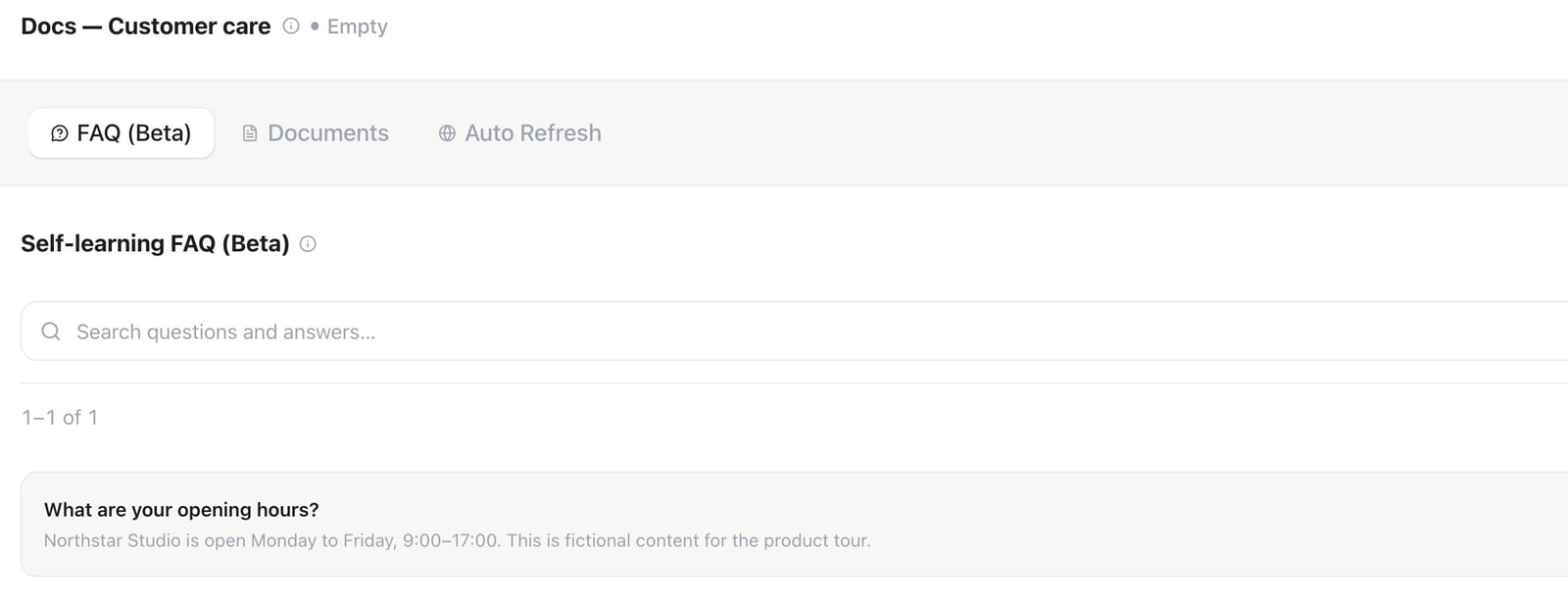
The **FAQ (Beta)** tab appears once **Beta Features** is on under **Settings → Workspace**. Question-and-answer pairs can be written directly under **Entries** — a lighter alternative to uploading a document. Independently of that, the **Inbox** collects factual customer questions that did not have a useful knowledge result. Review a proposed answer, edit it, and select **Approve & publish** before it becomes part of the knowledge base.
## List documents and indexed chunks
The document list shows every item in a knowledge base — uploaded files, text, file URLs, web pages, crawled website pages and cloud drive files — with its status and number of indexed chunks.
For API or MCP access, use `GET /knowledge-bases/{id}/documents` or `list_knowledge_documents`. Results are sorted newest first and paginated with `limit` (1–200, default 50) and `offset` (default 0). The API returns the total number of documents in `meta.pagination.total`; MCP returns `total`. An unknown or invalid knowledge base ID returns a not-found error.
Pass a document ID from that list to `GET /knowledge-bases/{id}/documents/{docId}/chunks` or `list_document_chunks` to read the exact passages indexed for that document. Listing documents or chunks only reads the current index; it never refreshes a source or uses credits. API access requires `knowledge:read`; MCP also accepts `assistants:read`.
## Delete documents
Hover over a document in the list and tick its checkbox (on touch screens the checkboxes are always shown). Once a document is selected, the bar above the table lets you select all documents, clear the selection or delete the selected documents. Deleting removes the documents, their indexed chunks and their stored original files, so assistants stop using that content right away. Pages from an Auto Refresh website come back on the next refresh unless you add them to that source's **Exclude paths**; files from a cloud drive come back on the next sync unless you remove them from the synced folder.
| | One document | Several documents (up to 200) |
| - | - | - |
| API | `DELETE /knowledge-bases/{id}/documents/{docId}` | `POST /knowledge-bases/{id}/documents/delete` with `document_ids` |
| MCP | `delete_documents` | `delete_documents` |
| CLI | `famulor delete-knowledge-base-document ` | `famulor delete-knowledge-base-documents --document-ids ,` |
IDs that do not exist in this knowledge base, or were already deleted, are returned in `not_found_ids` instead of failing the request, so a retry is safe. API access requires `knowledge:write`; MCP also accepts `assistants:write`.
## Write content that answers well
* Use a clear heading for each topic.
* Keep the facts and conditions needed for an answer in the same section.
* Put important numbers in text, not only in complex tables.
* Remove outdated or contradictory copies.
* Prefer one subject per document where practical.
* Watch latency on very large knowledge bases, especially many heavy PDFs — converting core content to text files usually processes and retrieves faster.
## Import a website
Add a website source with a root URL. You can limit it to selected path prefixes, exclude unwanted sections, and set the maximum number of pages to import. A path such as `/produkte` covers every page that starts with it; end a path with `$` to match only that exact page, for example `/datenschutz$`.
Before saving, choose **Load pages** beside **Website URL** to preview crawlable same-host pages. The preview checks `robots.txt` and available sitemaps, does not index anything, and spends no credits. Review the suggested sections, then explicitly add a path to **Include paths** or **Exclude paths**; suggestions are never saved automatically. Suggested exclusions also list privacy, cookie and accessibility pages; the imprint and terms pages are never suggested.
Each previewed page has a checkbox. Ticking or unticking a page updates **Include paths** and **Exclude paths** for you with an entry for exactly that page (ending in `$`, for example `/impressum$`), and a counter shows how many pages are selected. **Maximum pages** follows your selection: it rises automatically so every include path and every ticked page fits, and you can also type an exact number. If you set it lower than the number of matching pages, the dialog warns you, because pages beyond the limit are not indexed. A source under **Auto Refresh** shows the same warning when it has more include paths than its page limit. A page that a broader exclude path such as `/blog` removes can only be changed in **Exclude paths**.
Run the import once, or enable automatic synchronization to check the site again at your chosen interval, from every 6 hours up to every 6 months. Only new or changed pages use import credits.
Give each auto-refresh source a custom name when you add it. This is the name shown under **Auto Refresh**; it does not change the website URL or connected folder. Choose **Edit** on the source later to rename it or change its refresh settings.
Choose **Load pages** on a website source to view paths whose indexing is complete. Loading this list only reads the current index; it does not refresh the website or use credits.
For API or MCP access, use `GET /knowledge-bases/{id}/crawl-sources/{sourceId}/pages` or `list_crawl_source_pages`. Both return only ready, indexed pages and never start a refresh or use credits.
To run the same pre-save preview through API or MCP, use `POST /knowledge-bases/{id}/crawl-sources/discover` or `discover_crawl_source_paths`.
Website imports:
* follow pages on the same host; without a sitemap they also read pages outside your include paths for links, but never index those pages,
* respect website crawling rules,
* work best with pages whose main text is present in HTML,
* leave out cookie banners and menus,
* split each page along its headings, so every indexed passage keeps the page title and section name,
* skip error pages, pages without readable content, and unsupported or oversized pages; skipped pages are not indexed, use no credits, and never replace a page that was indexed before, and
* index pages with identical content only once; a page that already has its own entry keeps being updated.
If a site loads all meaningful text only after JavaScript runs, add its content as documents or direct text instead.
## Cloud drive sync
Add a Google Drive, OneDrive, Box, Dropbox, or SharePoint folder as a knowledge-base source that stays up to date automatically, the same way a website source does. Connect the account under **[Automations → Connections](/automations/overview)** first if it isn't connected yet — an OAuth sign-in, not a pasted key — then add the folder as a source and pick that connection. SharePoint additionally requires the document library's drive ID — a folder path alone isn't enough to list its contents.
Run a sync once, or turn on auto-sync to check the folder again on your chosen interval, from every 6 hours up to every 6 months. Only new or changed files use sync credits.
Cloud drive sync is Beta: turn on **Beta Features** under **Settings → Workspace** before the cloud-drive options appear. It is gated by its own plan feature, separately from website crawling, and billed per synced file at twice the per-page website-crawl rate — listed as **KB cloud drive sync file** on the [Usage page](https://app.famulor.io/usage), where you can check your current rates.
For API or MCP access, use `GET`/`POST /api/v1/knowledge-bases/{id}/drive-sources`, `GET`/`PATCH`/`DELETE /api/v1/knowledge-bases/{id}/drive-sources/{sourceId}`, and `POST /api/v1/knowledge-bases/{id}/drive-sources/{sourceId}/run`, or the MCP tools `list_drive_sources`, `create_drive_source`, `update_drive_source`, `delete_drive_source`, `run_drive_source`.
## Self-learning FAQ (Beta)
The **FAQ (Beta)** tab appears once **Beta Features** is on under **Settings → Workspace**. Question-and-answer pairs can be written directly under **Entries** — a lighter alternative to uploading a document. Independently of that, the **Inbox** collects factual customer questions that did not have a useful knowledge result. Review a proposed answer, edit it, and select **Approve & publish** before it becomes part of the knowledge base.
 Assistant-generated proposals are never published automatically. Depending on the assistant setting, Famulor can collect only the question, prepare a private draft, or share a clearly tentative answer during the conversation.
Select **+** immediately before the **Entries / Inbox** tabs to open a new FAQ and focus its question field. Closing the form keeps your draft. When questions need review, the numbered notice opens all pending questions in the Inbox, clearing its search and status filter. The notice counts questions awaiting review, not unread messages.
Use **Search FAQs** in **Entries** or **Inbox** to search all questions, answers and proposed answers in that section. Search ignores case and treats the text literally. Inbox status filters apply before results are split into pages of 25. The page controls show the matching total and let you move to the first, previous, next or last page. The Inbox badge always counts all open entries, including those outside the current search. Unsaved edits remain available when you search, change filters or move between pages in the same knowledge base.
For API access, use `GET /api/v1/knowledge-bases/{id}/faqs` with optional `search` (up to 200 characters), `status` (one or more comma-separated statuses), `limit` (1–200, default 50) and `offset` (default 0). For example, `?status=needs_answer,needs_review&search=opening%20hours&limit=25&offset=25` returns the second page of matching open entries. The MCP tool `list_faq_entries` accepts the same search and pagination options; its status filter accepts one value or an array of values. The API returns the matching total in `meta.pagination.total` and the total open count in `meta.pending`; MCP returns `total` and `pending`.
## Availability and limits
The number of knowledge bases and access to website import depend on your plan. If your plan's included number of knowledge bases isn't enough, buy additional slots from **Settings → Plan** as the **Extra Knowledgebases** add-on, priced per knowledge base per month. Current per-knowledge-base limits are:
| Resource | Limit |
| - | - |
| Files | 25 files, up to 20 MB each |
| URLs | 500 |
| Text entries | 50 |
| CSV, TSV or XLSX | 1,000 rows and 50 columns |
Website imports are billed in credits per new or changed page, at the workspace's **KB crawl / auto-sync page** rate — current rates are on the [Usage page](https://app.famulor.io/usage). The source shows progress and any action needed if the available credit balance is exhausted.
## Tables: CSV, TSV, XLSX and Google Sheets
Upload a rectangular table with its column headings in the first populated row.
CSV supports comma or semicolon delimiters and quoted multiline cells; TSV uses tabs.
Use UTF-8, or UTF-16 with a BOM. Legacy XLS files must be saved as XLSX or CSV.
XLSX includes every sheet, including hidden sheets. Google Sheets use the existing
Drive connection and include every exported sheet; exports over 10 MB fail explicitly.
Existing unchanged sources keep their previous index until the source changes or is reimported.
Each result keeps the original cell values, column positions, file, sheet and row.
Duplicate or empty headings receive distinct positional labels. CSV row numbers
refer to logical records, including blank records; a quoted multiline cell is one record.
XLSX references use worksheet row numbers. Search can match an exact identifier or
find a row from its description. Quote a whole value to request exact matching.
Similar identifiers are never evidence for a missing identifier. Multiple matching
rows require clarification. Indexed values are snapshots, not live inventory or prices.
Tables are limited to 1,000 records including headings across all sheets, 50 columns,
20 sheets and 6,000 characters per rendered row. XLSX expansion is limited to 32 MB.
Merged cells and values beyond the header width are rejected; split separate tables
onto separate sheets. The original table file is retained. A failed replacement
keeps the previous searchable index and reports the error.
Formulas are not recalculated. Cached formula results are clearly marked unverified;
missing results and cell errors remain unavailable. Ambiguous date/number text is
preserved without guessing a locale. Verify those values in the source before answering.
Use `POST /knowledge-bases/{id}/search` or the `search_knowledge_base` MCP tool.
Natural-language search returns source references and positional column keys.
For complete-sheet filters or totals, pass a table query using those references:
rows, count, sum, minimum or maximum; at most five equality/range filters combined
with AND. Numeric and date ranges require an explicit type. Numeric totals reject
missing, ambiguous, formula or mixed-currency values in matching rows. Results
include the number of matching rows and indicate when the displayed rows are limited.
Never calculate a full-table total by adding the few excerpts returned by search.
Joins, arbitrary expressions, currency conversion and formula evaluation are unsupported.
### Retry an existing document
Use **Retry** on a document that failed to process. API clients can send
`POST /api/v1/knowledge-bases/{id}/documents` with only
`{"document_id":"44444444-4444-4444-8444-444444444444"}`. With MCP, call
`add_document` with the knowledge base ID and the same document ID. Omit new
content, a file URL, a name and a description when retrying.
Both perform the same synchronous retry as the UI. A cloud drive document is
downloaded again from its current source, even if its version is unchanged.
Only that file is processed and charged at the normal sync rate; other documents
are neither refreshed nor removed. Drive access, sufficient credits and an
available sync slot are required. The previous searchable index remains usable
if processing fails. Folder discovery checks at most 500 files; if the target
falls outside that limit, use a smaller source folder. Other source types retry
their retained file or website; an uploaded original that has already been
purged and has no remote source must be uploaded again.
The API returns HTTP 200 with the document ID, processed/total chunk counts and
whether text was truncated; MCP returns the same fields. Failures return an
error. Creating new content still returns HTTP 201. API access requires
`knowledge:write`; MCP accepts `knowledge:write` or the existing
`assistants:write` scope. Both require a workspace role allowed to write.
## Knowledge source access
Website crawling and cloud drive sync are separate plan features. Scheduled refresh also requires Auto-sync. If a feature is unavailable, ask your workspace administrator about a plan that includes it. Whitelabel operators can configure these permissions in customer plans and prepaid defaults. Cloud drive sources also require Beta Features in your workspace. New or changed content is charged in credits.
This documentation is built and hosted on [Mintlify](https://mintlify.com), a developer documentation platform.
Assistant-generated proposals are never published automatically. Depending on the assistant setting, Famulor can collect only the question, prepare a private draft, or share a clearly tentative answer during the conversation.
Select **+** immediately before the **Entries / Inbox** tabs to open a new FAQ and focus its question field. Closing the form keeps your draft. When questions need review, the numbered notice opens all pending questions in the Inbox, clearing its search and status filter. The notice counts questions awaiting review, not unread messages.
Use **Search FAQs** in **Entries** or **Inbox** to search all questions, answers and proposed answers in that section. Search ignores case and treats the text literally. Inbox status filters apply before results are split into pages of 25. The page controls show the matching total and let you move to the first, previous, next or last page. The Inbox badge always counts all open entries, including those outside the current search. Unsaved edits remain available when you search, change filters or move between pages in the same knowledge base.
For API access, use `GET /api/v1/knowledge-bases/{id}/faqs` with optional `search` (up to 200 characters), `status` (one or more comma-separated statuses), `limit` (1–200, default 50) and `offset` (default 0). For example, `?status=needs_answer,needs_review&search=opening%20hours&limit=25&offset=25` returns the second page of matching open entries. The MCP tool `list_faq_entries` accepts the same search and pagination options; its status filter accepts one value or an array of values. The API returns the matching total in `meta.pagination.total` and the total open count in `meta.pending`; MCP returns `total` and `pending`.
## Availability and limits
The number of knowledge bases and access to website import depend on your plan. If your plan's included number of knowledge bases isn't enough, buy additional slots from **Settings → Plan** as the **Extra Knowledgebases** add-on, priced per knowledge base per month. Current per-knowledge-base limits are:
| Resource | Limit |
| - | - |
| Files | 25 files, up to 20 MB each |
| URLs | 500 |
| Text entries | 50 |
| CSV, TSV or XLSX | 1,000 rows and 50 columns |
Website imports are billed in credits per new or changed page, at the workspace's **KB crawl / auto-sync page** rate — current rates are on the [Usage page](https://app.famulor.io/usage). The source shows progress and any action needed if the available credit balance is exhausted.
## Tables: CSV, TSV, XLSX and Google Sheets
Upload a rectangular table with its column headings in the first populated row.
CSV supports comma or semicolon delimiters and quoted multiline cells; TSV uses tabs.
Use UTF-8, or UTF-16 with a BOM. Legacy XLS files must be saved as XLSX or CSV.
XLSX includes every sheet, including hidden sheets. Google Sheets use the existing
Drive connection and include every exported sheet; exports over 10 MB fail explicitly.
Existing unchanged sources keep their previous index until the source changes or is reimported.
Each result keeps the original cell values, column positions, file, sheet and row.
Duplicate or empty headings receive distinct positional labels. CSV row numbers
refer to logical records, including blank records; a quoted multiline cell is one record.
XLSX references use worksheet row numbers. Search can match an exact identifier or
find a row from its description. Quote a whole value to request exact matching.
Similar identifiers are never evidence for a missing identifier. Multiple matching
rows require clarification. Indexed values are snapshots, not live inventory or prices.
Tables are limited to 1,000 records including headings across all sheets, 50 columns,
20 sheets and 6,000 characters per rendered row. XLSX expansion is limited to 32 MB.
Merged cells and values beyond the header width are rejected; split separate tables
onto separate sheets. The original table file is retained. A failed replacement
keeps the previous searchable index and reports the error.
Formulas are not recalculated. Cached formula results are clearly marked unverified;
missing results and cell errors remain unavailable. Ambiguous date/number text is
preserved without guessing a locale. Verify those values in the source before answering.
Use `POST /knowledge-bases/{id}/search` or the `search_knowledge_base` MCP tool.
Natural-language search returns source references and positional column keys.
For complete-sheet filters or totals, pass a table query using those references:
rows, count, sum, minimum or maximum; at most five equality/range filters combined
with AND. Numeric and date ranges require an explicit type. Numeric totals reject
missing, ambiguous, formula or mixed-currency values in matching rows. Results
include the number of matching rows and indicate when the displayed rows are limited.
Never calculate a full-table total by adding the few excerpts returned by search.
Joins, arbitrary expressions, currency conversion and formula evaluation are unsupported.
### Retry an existing document
Use **Retry** on a document that failed to process. API clients can send
`POST /api/v1/knowledge-bases/{id}/documents` with only
`{"document_id":"44444444-4444-4444-8444-444444444444"}`. With MCP, call
`add_document` with the knowledge base ID and the same document ID. Omit new
content, a file URL, a name and a description when retrying.
Both perform the same synchronous retry as the UI. A cloud drive document is
downloaded again from its current source, even if its version is unchanged.
Only that file is processed and charged at the normal sync rate; other documents
are neither refreshed nor removed. Drive access, sufficient credits and an
available sync slot are required. The previous searchable index remains usable
if processing fails. Folder discovery checks at most 500 files; if the target
falls outside that limit, use a smaller source folder. Other source types retry
their retained file or website; an uploaded original that has already been
purged and has no remote source must be uploaded again.
The API returns HTTP 200 with the document ID, processed/total chunk counts and
whether text was truncated; MCP returns the same fields. Failures return an
error. Creating new content still returns HTTP 201. API access requires
`knowledge:write`; MCP accepts `knowledge:write` or the existing
`assistants:write` scope. Both require a workspace role allowed to write.
## Knowledge source access
Website crawling and cloud drive sync are separate plan features. Scheduled refresh also requires Auto-sync. If a feature is unavailable, ask your workspace administrator about a plan that includes it. Whitelabel operators can configure these permissions in customer plans and prepaid defaults. Cloud drive sources also require Beta Features in your workspace. New or changed content is charged in credits.
This documentation is built and hosted on [Mintlify](https://mintlify.com), a developer documentation platform.